
 Apple Podcasts
 Spotify
 RSS Feed
 iHeartRadio
 PocketCasts
 Amazon Music
 Pandora
 The Last One To Know I'm Dying
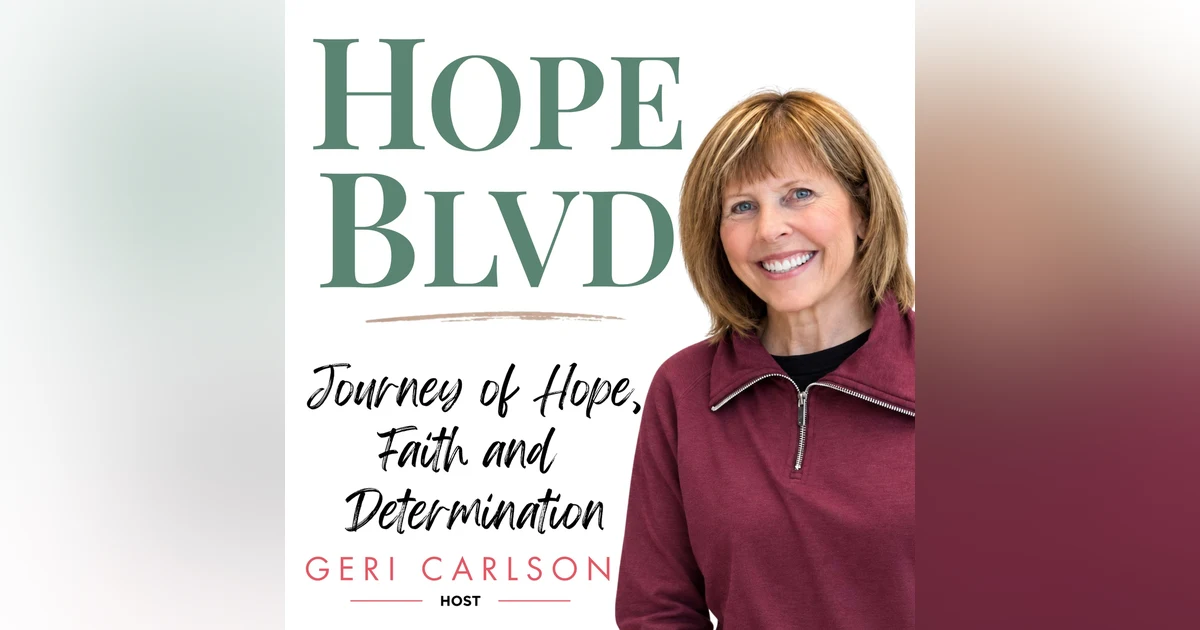

From tertiary hospital to rehab facility and nursing home, this is part 1 of a 2-part story, one of the hardest parts of my journey.
There is always hope. Always.
Journey of hope, faith and determination.
Much love and blessings,
Geri
https://www.HopeBlvd.org - Podcast episodes and more.
https://www.GeriCarlson.com - Geri's story, About her, the services she provides, and more. To inquire about Geri's counseling or coaching services, go to the Contact page and leave her a message.
https://Porphyria.org - Geri's type is Variegate Porphyria (VP), a subtype of Acute Hepatic Porphyria (AHP). Geri is an ambassador (advocate) for The United Porphyria Association. She also serves on the UPA's President's Council board.
Note: Transcript is lightly edited.
Geri Carlson, MA, MMin
Intro & Welcome
SpeakerToday, I'm going to talk about a hard part of my story. And it's one of the most important parts of my story to tell. And I have held back from telling it so far, but it's an important piece. So I think I need to share it. All right, why don't you join me? Welcome to Hope Blvd. This is Geri Carlson. Thank you so much for tuning into the show. This is episode number nine. Okay, we are really close to the double digits. So I am glad that you're here. Thank you for tuning in. And this is a tough part of my story to tell. And I'm just gonna be real about that. So let's get started. After
Destination: Rehab?
Speakerbeing in a tertiary hospital for some months, okay. For anyone who doesn't know what a tertiary hospital is, it is a huge teaching hospital where they do research and they often have state-of-the-art equipment and testing and that kind of thing. So a huge place, very reputable. Um, I was taken care of very well there. And but once I left there, things went downhill. And in the tertiary hospital, that's where they discovered I have variegate porphyria, that very rare genetic blood disorder I've talked about. And that's the thing that caused me to become paralyzed from a really severe attack. I became paralyzed from the neck down for nearly a year. And after I left there, I mean, I was transferred to an advanced rehab hospital closer to home, which was good. And this facility was phenomenal. It was state of the art, it was fantastic. But I was only there for four weeks and the insurance company just didn't want to pay for it.
Slim Pickings
SpeakerSo then I was transferred to another facility. Well, because I have porphyria, not many facilities are willing to take someone with such a rare disease because they don't know anything about it. And I get that. I respect the fact that they're going to, you know, resist accepting me, but that means slim pickings for facilities to go to and facilities to choose from. So I ended up at one facility that my family and I thought sounded like it was the best. My family went to visit it. Things seemed okay. They told me that it was just temporary. And so we thought I might be there for a few weeks and then come home. Unless I was getting really good rehab care there, then I would have stayed longer. But that wasn't the case. So after I was at this new facility, it was a basically a nursing home slash rehab center. Now there are some nursing home slash rehab centers that are fantastic and they do a great job, and they have terrific physical therapists, and I can't speak to all of them. I can only speak to the one I was at. And the one I was at was lacking, especially in the rehab department. There were some good physical therapists, or at least one good physical therapist there, and there was a great speech pathologist and nurses and some staff members. There were many wonderful people there. And there were a few that were lacking.
Angel Nurse
SpeakerI have to add that there was this one particular nurse who made it almost worthwhile being there. She was, well, I'll call her Teresa because she was almost like a Mother Teresa. I mean, she did the job that nobody else wanted. Look, I imagine that there are some nurses that probably wanted to avoid me because I was a lot of work. And this woman, this angel nurse, have you ever had the experience when someone walks in the door? You just think you hear angels singing. I mean, I imagine that. This woman would walk in the door. She was this fabulous nurse that she always went right to my wounds, and especially the wounds on my feet. And they were pretty scary, actually. They had gotten really bad. And she did all the hard stuff. She did the debreing, she did the treatment, she took the pictures, she took the measurements. I mean, she went above and beyond, went out of her way. She basically she did her job, and then some. But the spirit in which she did it is a master class. She's amazing. And we still keep in touch today because she had really made that much of an impression on me and my family. We love her.
Negligent Doctor
SpeakerAnd then there was the main doctor who was more than lacking, he was negligent. And his negligence caused me to almost die. So here's the thing. I was in this facility for less than two weeks at first. And the doctor never came in to lay eyes on me ever. After about 10 days or so, I was not feeling well. But you know what? Um, I'd been in the hospital for many months at that point, so I was not exactly feeling chipper at any point, but this was something different. I developed a cough and the cough seemed to be getting worse. And my husband notices those things in me before I noticed them. I think because I tend to downplay it and say things like, oh, I don't think it's any worse than yesterday, or nah, it's about the same. And I don't think it's that bad. I think it's fine. Well, my husband started to see that I was really weak. My voice was really weak. And that's something that I think my family know this is in me when I start really getting sick or when things are not going well. So my voice gets really weak at very low. And, you know, then there was the cough and I wasn't feeling well. And my husband had asked, you know, could you draw some labs or something? Or maybe check for a UTI, since I had been so prone to getting those lately. Once the severe porphyria attack came on months before, I seemed to have a UTI every month, or sometimes more often, honestly, I had many. And so it started to become the thing to look for. Like, okay, let's check and see if she has a UTI. Let's start there. So my husband asked for a test for a UTI, and the doctor at the facility, who kind of oversees things, had said, no, she's not running a fever, so there's no sense in checking for a UTI. And my husband let the nurse know, well, you can tell the doctor that my wife rarely runs a fever, even if she's really ill. She doesn't spike a fever until things are pretty bad. And this doctor refused to run a UTI. So he asked, okay, can you run some other labs and just see if she's, you know, how's her blood count or whatever? Something's just not right. And by the way, she's not breathing as well. And they refused.
Porphyria Expert
SpeakerSo what my family did in times like that when things weren't going well, was they would contact my geneticist. I've mentioned her. I love her. I am here in large part because of her. She is a lifesaver. She was and continues to be my strongest advocate. And when things aren't going well, you know, she's the one who oversees my porphyria for the most part. She's the poryphyria expert. And so whenever things aren't going well, we tend to reach out to her because she will get things done. And by golly, she did. So she called this facility and told the doctor, I want my patient to have a urinalysis and I want blood work drawn on her right away. And I don't recall if they even did it. I don't think that they even did. But at one point, my husband called her back and she told him, you need to call an ambulance and get her out of there right now. And that's what Rob did. He called an ambulance, got me out of the nursing home, and they took me to an emergency room, which was a really nice emergency room in a smaller hospital. But they had told us, you know what, you're just too sick for our hospital. We need to send you to a larger hospital.
Too Many To Count
SpeakerSo I was transferred again to another hospital, a fantastic facility in northern Indiana, and I'm really grateful for them. They took good care of me. I was in this hospital for about five days or so. And then things started to get worse. Here's the thing: here's what they told us. When I was admitted, I not only had a UTI, I had influenza A, pneumonia, pleural effusion, and a partially collapsed lung. I mean, there were so many things wrong. And I was filled with blood clots. They were in my legs, there were many in my lungs, and when I asked the doctor how many, he said too many to count. And they let us know that this was really serious. And I was placed in an intensive care unit, and my breathing started to get worse. I had been on oxygen, but at one point, before they even brought me into intensive care, what precipitated that was the fact that I wasn't breathing well. And the nurse came on staff and she came in to check on me, and she checked my oxygen, she listened to my lungs, and uh she turned around, did something on her computer, and all of a sudden people started walking into my room. What I didn't realize is that this nurse had called a respiratory code, and there were many people walking in my room just casually, not like in an alarming way or anything. It was just people started to enter. And I didn't know who they were or why they were there, but one by one, a couple of them came to the bedside and asked me questions and listened to my lungs, but they started taking things apart and started getting me ready for transfer.
The Last One To Know
SpeakerAnd I said, um, what's going on? And they said, We think it's best that we take you to the intensive care unit. And I said, Why? I'll tell you what, I am always the last one to know that I'm dying. Okay. I don't know what it is, but I'm the last person to know that, hey, things are getting serious or things are worsening. Oh, they are? I mean, I don't know what's wrong with me that I don't, I think I really downplayed to such a degree that it's not good. I don't do that in others. If I see that in my husband, I jump on it. If I see that in my kids, my grandchildren, I am gonna comment, I'm right there. But me, it's not a big deal, you know. So, I mean, there were more than a dozen people in my room and people in the hallway. And so I thought, what's going on? And when they explained, I'm going to the intensive care unit. When I got to the intensive care unit, that's really when they started to explain more to me.
The Ventilator
SpeakerAnd after I was there for a while, they wanted to put me on a ventilator. And I said, no. I mean, come on, this was a few years after COVID, and there were too many people that went on ventilators during COVID that never came off or that died when they were put on a ventilator. And I thought, nope, I'm not gonna put myself through that. I'm not gonna do it. And if I am not gonna make it, I'm not gonna make it, but I'm not going on the ventilator. Look, I'm not suggesting that that's the best decision. I'm just saying that that was the decision that I made for me at the time. That was really where I was. It was not an easy place to be. My family was put on high alert, and things went from bad to worse.
Bad To Worse
SpeakerWell, this is an interesting place to land. Although I wasn't planning on doing a cliffhanger, I'm going to end this on this episode and continue it on the next, and that will be coming out really soon. So, this is the part of the story where things escalate pretty quickly, and there is still so much more to tell. So I hope you'll join me on the next episode.
Stay Tuned
SpeakerThank you for listening. I appreciate you hanging in here and listening to the end. I hope you'll join me on the next episode to hear the rest of this story. As Paul Harvey used to say, to hear the rest of this story. Am I dating myself, Paul Harvey? He was a wonderful radio broadcaster back in the day, as they say. Oh, nostalgia. And with that, if any part of this story is interesting or encouraging, please share it with someone. And if you haven't done so already, I'd love for you to join my email list. So please go to hopeblvd.org. That's hopeblvd.org, and you'll see my email list. And thank you so much for being here. I really appreciate you listening. All right. In the meantime, make it a great day for you and someone else. And remember, friends, there is always hope. Always. Bye for now.